
An afternoon of music for theremin, ondes Martenot and piano
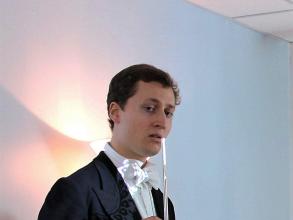
Last Saturday afternoon, Charlie Draper (Ertegun alumnus, 2012) and Andrew Frampton (DPhil student, music) treated friends of the Ertegun house to a delightful concert of music for piano and two uncommon instruments: theremin and ondes martenot. Named after their respective inventors, both of these machines translate nuanced movements of the performer's hands into electronically-produced pitches. Draper's ondes Martenot looked to be a simple electronic keyboard, but upon closer inspection, it boasted a number of knobs, switches, toggle-like keys, and even a string which can be used to manipulate the character of the sound. The theremin, on the other hand, operates without the performer even touching the instrument. Lacking the tactile assurance of keys or frets, the theremin player must quite literally pick the notes out of thin air.
Accompanied by Andrew on the piano, Charlie showcased the artistic capabilities of each of his instruments with works adapted for the duo as well as pieces composed specifically for these inventions. Charlie kindly took time after the concert to answer queries about the instruments, share their histories, and even let us try our hand at playing! However, it will surely take years of training and practice for any of us to reach the level of artistry which Charlie and Andrew displayed in this impressive and thoroughly entertaining performance.
Rose Campion
Charlie Draper and Andrew Frampton presented a recital of original and adapted music for theremin, ondes Martenot and piano, including works by Messiaen, Milhaud, and Rachmaninoff.
Charlie Draper (Ertegun alumnus, 2012) plays theremin and ondes Martenot. He has performed for the RTÉ Concert Orchestra, British Library, Tate Britain, London ExCEL Centre, and New York Public Theatre.
Andrew Frampton is reading for a DPhil in Music at Merton College Oxford and is active as a pianist and organist at the University. His current research specialisms include the music of Bach and his contemporaries, especially Jan Dismas Zelenka and Johann Friedrich Agricola; the latter provides a focus for his doctoral dissertation.
Theremin
The theremin has earned a place in history as the oldest manufactured electronic musical instrument, and the only expressive musical instrument to be controlled without physical contact from the player. Devised in 1920 by the Russian physicist and musician Leon Theremin (1896-1993), it is controlled by free movement of the hands around two electrostatic fields generated by metal antennas: the right hand controls the pitch, while the left hand controls volume. Its sound can be heard in numerous film scores from the 40s and 50s, as well as works by Dmitri Shostakovich, Bohuslav Martinů, Edgard Varèse, and Led Zeppelin.
Ondes Martenot
The ondes Martenot was patented in 1928 by French cellist and radio engineer Maurice Martenot (1898-1980). Its most well-known iteration is distinguished by three unique features: a laterally shifting keyboard (which permits vibrato), a ribbon control (which permits portamento), and special resonant speakers which imbue the sound with an otherworldly resonance. The instrument used in this recital is an Ondomo, a portable version of the instrument designed and built in Japan by Naoyuki Omo. The evocative tones of the ondes Martenot can recall a violin, cello, flute, or even a human voice, and attracted the attention of composers including Olivier Messiaen, Maurice Ravel, Tristan Murail, and Jonny Greenwood.


