Linguistic and Cultural Interactions between Greece and the Ancient Near East
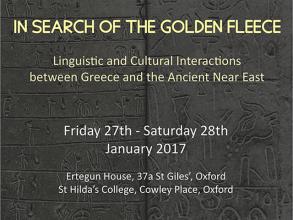
"In Search of the Golden Fleece": Linguistic and Cultural Interactions between Greece and the Ancient Near East.
Friday 27th January 2017 (afternoon), St Hilda's College, Cowley Place, Oxford, OX4 1DY
Saturday 28th January 2017 (all day), Ertegun House, 37A St Giles', Oxford, OX1 3LD
Hosted by the Ertegun Scholarship Programme and St Hilda's College, with the kind support of the Faculty of Linguistics, Philology and Phonetics of the University of Oxford, this two-day conference brought together international experts to discuss the issue of language and cultural contacts between Ancient Greece and its Eastern Neighbours, (especially the Indo-European populations of Anatolia) in the II and I millennia BCE.
A dinner with the speakers took place on January 27th at St Hilda's College.
Programme (to download the programme please click here)
Friday 27th January
2pm Registration & Welcome Reception
2.30pm Welcome address - M. Bianconi (Oxford)
2.45pm Homeric covenantal terminology and its Near Eastern forerunners - P. Dardano (Siena)
3.30pm Where was Aḫḫiya? Who was Attarissiya? - S. Durnford (Independent)
4.15pm Refreshments
4.45pm The literary evidence - from Hittite to Homer? - C. Metcalf (Oxford)
5.30pm Dynastic Marriage as an Engine for Religious Change: the Case of Assuwa and Ahhiyawa - I. Rutherford (Reading)
(papers end at 6.15pm)
7.00pm Drink reception and Dinner
Saturday 28th January
10.30am Refreshments
11.00am Language Contact between Lydian and Greek - N. Oettinger (Erlangen-Nürnberg)
11.45am Gods of the Lydians, Greco-Lydian Contact and the Problem of Lydian Ethno-Linguistic Identity - R. Oreshko (Warsaw)
12.30am Anatolian and Greek: languages in contact or common inheritance - J.L. García Ramón (Center for Hellenic Studies - Washington, Harvard University)
1.15pm Lunch
2.30pm Trends in writing and literacy: Greece and Phrygia, Cyprus and Phoenicia - P. Steele (Cambridge)
3.15pm Signs and Seals. Early writing and administrative practices in the Aegean and Anatolia - W. Waal (Leiden)
4.00pm Refreshments
4.30pm The linguistic Landscape of North West Anatolia in pre-Roman times - A. Kloekhorst (Leiden)
5.15pm A Possible New Greco-Carian Contact Phenomenon - H.C. Melchert (UCLA)
(papers end at 6.00pm)
Scholar's Report
This interdisciplinary seminar featured eleven invited world-renowned specialists from European and US universities (Oxford, Reading, Cambridge, Erlangen-Nuremberg, Cologne, Leiden, Siena, Warsaw, and UCLA), who are specialists in the fields of historical and comparative linguistics, ancient literatures, and writings of the ancient world.
The Search of the Golden Fleece, the myth I chose for the name of this symposium is the journey of a Greek hero towards the East, and conceptually represents what many scholars have done in the past decades, which is looking to the Near East in search of models that influenced Greek culture and literature in a very archaic age. I am also personally involved in this research: my thesis project consists of trying to figure out what were the relationships between Greek and the Indo-European languages of Anatolia before the Hellenistic period.
This has been - to my knowledge - an unicum in Europe, and generally one of the few scientific events organised on the topic: the only other one I know is a conference hold in Atlanta (GA) in 2004, whose papers are collected in a later volume ("Anatolian Interfaces: Greeks, Hittites and their Neighbours", published by Oxbow Books). But our colloquium has been innovative in that linguistics was the main focus, and the Greek and Anatolian 'sides' were equally represented.
It was meant to be something suitable for linguists, classicists, archaeologists and scholars of the Ancient Near East, and the turnout fully confirmed this assumption: according to my final count, the total number of attenders was 90, which exceeded my best expectations. Dozens of student and faculty members from Oxford, Cambridge, London participated, and we even had people coming over from Italy, Germany, Spain, France, Belgium, the Netherlands, Austria, Turkey, Israel, Canada and the United States. Also, and this is very important, we attracted also people who are not currently affiliated with an academic institution
It is a greatest privilege to have been able to gather such a wonderful array of speakers for an event centred on my own research interest. And more importantly, it has been an incredible pleasure to see how broad the interest around the subject was, and how everyone seemed to have a good time listening to the papers and enjoying the delightful environment of the Ertegun House.
I am immensely thankful to the Programme for the resources and the support, and in particular to our excellent administrator Jill Walker, who helped me with countless organisational matters. The resources the Ertegun Scholarship gives us Scholars are, in my opinion, unmatched, and the possibility to organise this sort of events (which, it is worth noting, are not part of a normal postgraduate student curriculum) could be an added value for our cv and constitute a substantial advantage for our future career choices. At the same time, this gives us the chance to experiment new forms of academic communication and put in place events that otherwise it would be much harder to organise (for e.g. funding restrictions) and that may bring together intellects from different backgrounds towards a common goal.
Michele Bianconi